
From TACO to NACHO
Plus, recalibrating the Canadian economy for negative population growth
We can all thank Paul Krugman for NACHO - not a chance Hormuz opens. The Trump administration continued to turn over its approach to Iran almost every other day this week. That was enough to string along the oil market and see US equities to new record highs, even as US and Iranian forces exchanged fire later in the week.
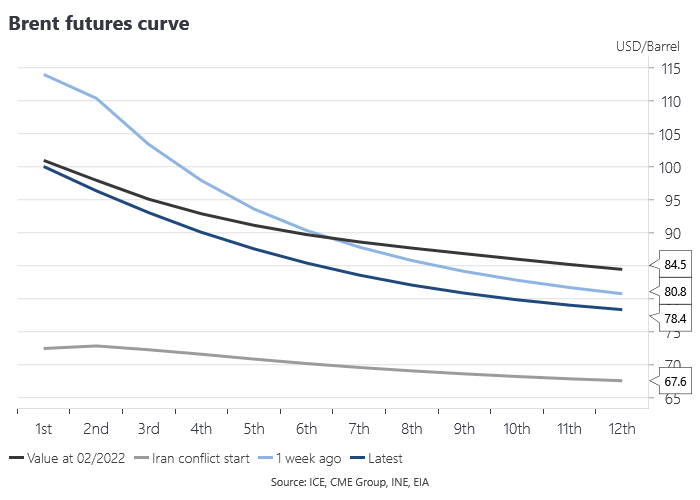
The Brent futures strip mostly sits comfortably below where it was a week ago, with the largest declines at the front end.
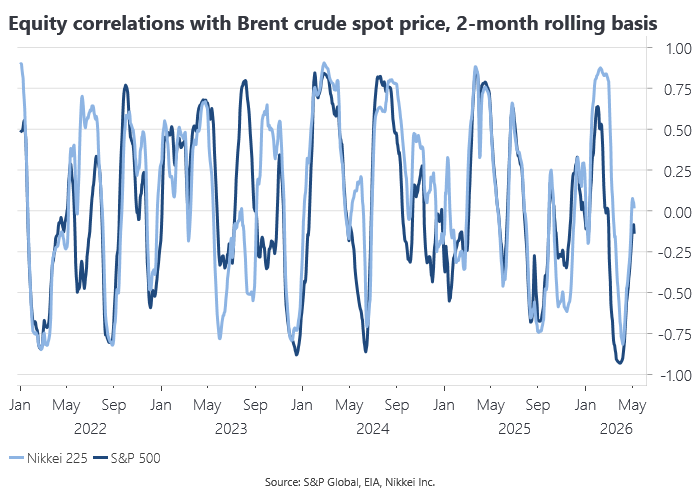
On a two-month rolling basis, which effectively captures the duration of the conflict to date, US equities show only a modest negative correlation with oil prices. The peak negative correlation of around -0.9 was on 1 April. Lest the low correlation be attributed to the US being a net energy exporter, we see an almost identical correlation between Brent and the Nikkei 225, Japan being a large net energy importer.
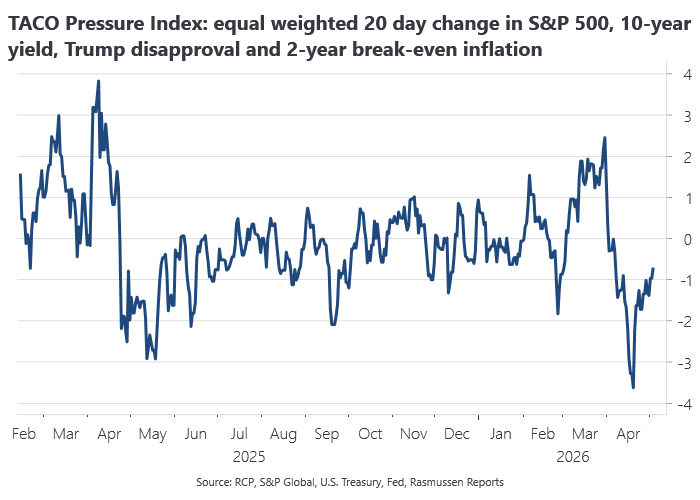
The broader US market has outperformed the megacaps and growth stocks have outperformed defensives since the ceasefire took effect on April 8. TACO pressure is higher, but remains in negative territory.
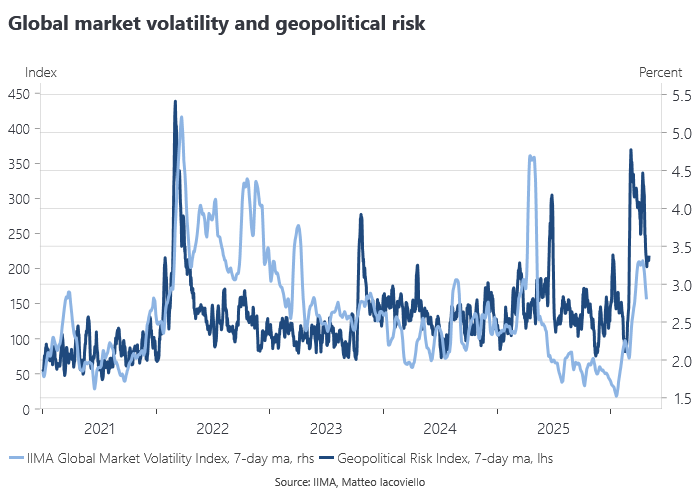
Global market volatility is rolling over along with measured geopolitical risk.
A key test of this seemingly benign sentiment would be the resumption of broader hostilities. US Secretary of State Marco Rubio said this week, ‘We cannot live in a world where a country can decide, now we own the international shipping lane.’ This was a problem the world did not have before the US initiated the conflict and one it clearly did not anticipate, but is now the main problem to solve. The military and sanctions levers have already been pulled without success. The situation is more conducive to further military escalation than a climb down on the part of the US administration.
This week’s RBA Statement on Monetary Policy conditioned its outlook on the Brent futures strip, which is a reasonable baseline assumption, but also reflects a lot of market hopium. For mine, a more robust assumption is that the Strait stays closed indefinitely. If there were a viable near-term resolution, we would already have a sense of what that might look like, but we don’t. By contrast, the escalatory path to a broader conflict is relatively clear because we are already on it.
